
Hida Takayama Tourist Guide

Takayama City, Gifu Prefecture, is a "Little Kyoto of Hida" with a townscape that retains its Edo period charm. Takayama Zenkoji is about a 5-minute walk from JR Takayama Station.If you stay at a shukubo, you can walk around and experience everything from the morning service to the morning market and the old townscape in one day.
4 Things to Do in Takayama

Walk the dark Kaidan-meguri
Go underground into the main hall of Takayama Zenkoji. Feel your way through the unlit corridor and touch the "key" directly beneath the principal image. Participation fee: 500 yen.
See the flow of Kaidan-meguri →
After the morning service, head to the morning market
Morning service is held in the main hall every morning from 7 AM. Afterwards, walk to the Jinya-mae Morning Market and Miyagawa Morning Market. This is the best way to enjoy Takayama in the morning.
See how to spend your morning →
Walk through the Old Town and Takayama Jinya
Stroll through streets lined with machiya (traditional townhouses) with lattice doors and sake breweries, then visit Takayama Jinya, which was an Edo shogunate government office. You can also savor Hida beef and Takayama ramen.
See walking routes and dining →
See the Takayama Festival and Miyagawa River cherry blossoms
During the Takayama Festival in April and October, floats lit with lanterns parade through the night town. In April, the cherry blossoms along the Miyagawa River are also in full bloom.
See Takayama Festival and cherry blossoms →Upcoming in Takayama — Nearby Events

1. Walk the Kaidan-meguri in darkness — Takayama Zenkoji

Takayama Zenkoji is a branch temple of Shinshu Zenkoji Daihongan in Nagano. Like Shinshu Zenkoji,it has a Kaidan-meguri (a dark corridor beneath the main hall) in the basement of its main hall.
In the Kaidan-meguri, you enter a subterranean corridor from the inner sanctuary of the main hall and proceed by feeling your way in the dark. Directly beneath the principal image (Go-honzon) hangs a lock called the "Key to Atonement and Paradise" (Senzai Gokuraku no Kagi).It is believed that by touching this key, one forms a connection with the Buddha and receives a promise of rebirth in paradise.,
| Item | Content |
|---|---|
| Location | Basement of Takayama Zenkoji Main HallGoogle Maps ↗ |
| Participation fee | 500 yen |
| Reception | Anytime. Please inform the temple staff. |
| From Takayama Station | Approx. 5 minutes walk from the East Exit |
Flow of Kaidan-meguri

- Worship in the main hall— Go up to the main hall and worship the principal image. The principal image, Ikko Sanzon Amida Nyorai, is an absolute secret Buddha, and its form cannot be seen.
- Go underground— Descend the stairs from the entrance of the inner sanctuary. Inside, it is pitch black, where you cannot see an inch ahead.
- Proceed by following the right wall— The "Key to Atonement and Paradise" is locatedon the right wall, at chest height.Proceed slowly while touching the wall with your right hand.
- Touch the key— Directly beneath the principal image, find and touch the key.
- See the light at the exit— When you see the light shining from the exit, you will feel the "blessing of light" that you usually do not consciously notice.
The lowest height inside is 180 cm. Taller individuals should watch their heads. There may be times when it is unavailable due to memorial services. In the darkness, you are not distracted by what you see. The meaning of this practice is said to be the time spent focusing solely on finding the key. Information about the history of Takayama Zenkoji and its garden "Niko Byakudo" is introduced at
In the darkness, you are not distracted by what you see. The meaning of this practice is said to be the time spent focusing solely on finding the key. Information about the history of Takayama Zenkoji and its garden "Niko Byakudo" is introduced atTemple Hotel Takayama Zenkoji.
2. Attend the morning service at 7 AM, then head to the morning market
At Takayama Zenkoji,a morning serviceis held in the main hall every morning from 7 AM. Guests staying at the temple can attend for free, and no reservation is required. Children are also welcome to attend.
| Item | Content |
|---|---|
| Start time | 7:00 AM daily |
| Location | Takayama Zenkoji Main HallGoogle Maps ↗ |
| Price / Reservation | Free for guests, no reservation required |


Sit on the tatami mats in the main hall and join your hands in prayer with the monk's chanting. Even if you cannot read the sutras, you can participate by simply sitting and listening. Please inform us of your attendance at check-in.
After the morning service, walk to the morning market
Takayama has two morning markets that open daily.After the morning service, let's walk directly to the morning market.Takayama Zenkoji recommends the Miyagawa Morning Market for early morning breakfast.


| Morning Market | Location | Time | From Takayama Zenkoji |
|---|---|---|---|
| Jinya-mae Morning Market | Square in front of Takayama JinyaMap ↗ | 7:00 AM - 12:00 PM (8:00 AM - 12:00 PM from November to March) | Approx. 5 min walk |
| Miyagawa Morning Market | East bank of Miyagawa River, between Kaji-bashi and Yayoi-bashi bridgesMap ↗ | 7:00 AM - 12:00 PM (8:00 AM - 12:00 PM from December to March) | Approx. 12 min walk |
- Miyagawa Morning Market— Shops line the Miyagawa River for about 700 meters. They sell local vegetables and fruits, wild plants, pickles, folk crafts, and seasonal flowers. In winter, miso, pickles, and mochi are also available. The market began as a vegetable market in the Meiji era and moved to its current riverside location in 1962.
- Jinya-mae Morning Market— This morning market is held in front of the Takayama Jinya. After browsing, you can proceed directly to tour the Jinya.
Both markets are open year-round. Shops close early once their goods are sold out, so visiting earlier in the day offers a wider selection of items.
(Morning service at Takayama Zenkoji, morning markets based on information from Hida Takayama Tourism Convention Association's "Hida Takayama Miyagawa Morning Market" and Gifu Prefecture Tourism Federation)
3. Strolling through the Old Town and Takayama Jinya — Eating and Shopping in Takayama
The Old Town (Sanmachi)is an area that was a merchant district of a castle town during the Edo period. Machiya (traditional townhouses) with projecting lattice windows line the streets, and waterways flow under the eaves. Three streets have been designated as a National Important Preservation District for Groups of Traditional Buildings.
- Sake Breweries— There are seven sake breweries in the Old Town. Look for the "sakabayashi (sugidama)" (cedar balls) hanging from the eaves as a landmark.
- Shop Hours— Most shops are open from around 9:00 AM to 6:00 PM, and some are closed on Tuesdays or Wednesdays. Shops start closing in the evening, soshopping before noonis recommended.
- From Takayama Zenkoji— Approximately a 10-minute walk.Map ↗

Takayama Jinya — The only remaining magistrate's office in Japan
Takayama Jinya Map ↗Takayama Jinyais the building of the government office (gun-dai/daikan-sho) that ruled Hida during the Edo shogunate. This is the only place in Japan where the original building from that period remains, and it is designated as a National Historic Site. It is about a 5-minute walk from Takayama Zenkoji, right behind the Jinya-mae Morning Market.
| Opening Hours | April - October: 8:45 AM - 5:00 PM / November - March: 8:45 AM - 4:30 PM (Last admission 30 minutes before closing) |
|---|---|
| Admission Fee | 500 yen (Free for high school students and younger) |
| Closed | December 29 - 31, January 1 |
Hida Beef, Takayama Ramen, Mitarashi Dango
- Hida Beef— This is the representative wagyu beef of Gifu Prefecture. Many restaurants in Takayama serve Hida beef.
- Takayama Ramen (Chuka Soba)— Thin, curly noodles in a light soy sauce broth with a Japanese dashi base. It is said that the "Takayama style" involves combining and simmering the soup and sauce in a single pot. The origin is said to be a shop founded in 1938.
- Mitarashi Dango— Takayama's mitarashi dango are grilled with soy sauce, not a sweet sauce.
Near Takayama Zenkoji, you'll find Hida beef restaurant "Maruaki," local cuisine restaurant "Hakkakutei," and izakaya "Entaku." There are also convenience stores and supermarkets within walking distance.
Business days and hours vary by store and may change. Please check with each store before visiting.
(Old Town, Takayama Jinya, and Takayama Ramen information is from the official website of the Hida Takayama Tourism Convention Association)
4. See the Takayama Festival and Miyagawa Cherry Blossoms

Takayama Festivalis the collective name for the spring "Sanno Festival" and the autumn "Hachiman Festival." The "Takayama Festival Float Event" is registered as a UNESCO Intangible Cultural Heritage.
| Spring Takayama Festival (Sanno Festival) | Autumn Takayama Festival (Hachiman Festival) | |
|---|---|---|
| Dates | April 14th & 15th every year | October 9th & 10th every year |
| Shrine | Hie Shrine | Sakurayama Hachimangu Shrine |
| Venue | South side of the Old Town (south of Yasukawa Street) | North side of the Old Town (north of Yasukawa Street) |
| Evening Events | Night festival on the 14th | Yoimatsuri (evening festival) on the 9th (18:00-21:30) |
| From Takayama Zenkoji | Approx. 15 min walk | Approx. 20 min walk |
- Parade of Festival Floats— Luxurious floats line up around the shrine.
- Karakuri Dedication— Karakuri (mechanical doll) performances are dedicated on top of the floats.
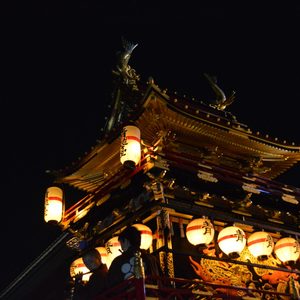
- Evening Festival / Eve Festival— As dusk falls, many lanterns are lit on the floats, which then parade through the old townscape.

On festival days, cars are not allowed around the venue.If you stay at a shukubo (temple lodging), you can walk back after watching the evening festival.Events may be canceled due to weather conditions on the day and will not be postponed. For the schedule of autumn events,Autumn Takayama Festival (Hida Takayama Tourism Convention Association)please check.
Cherry blossoms along the Miyagawa River (typically mid-to-late April)


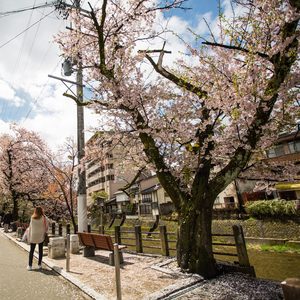
Cherry trees line the banks of the Miyagawa River, which flows through the center of town, creating a quintessential spring scene in Takayama when combined with the red Nakabashi Bridge. The best time to see them is usually from mid-to-late April, often coinciding with the Spring Takayama Festival. Nakabashi Bridge is about an 8-minute walk from Takayama Zenkoji.Walking in the morning when there are fewer peopleis recommended.Map of Nakabashi Bridge ↗
Walking through the Higashiyama Temple Area — Higashiyama Walking Course
At the foot of the eastern mountains of the old townscape,Higashiyama Temple Areais a cluster of temples and shrines stretching north to south. They were strategically placed by the Kanamori clan, who ruled Hida in 1585, when they developed the castle town.
The Higashiyama Walking Courseis well-maintained, allowing you to trace the temple and shrine grounds in order. It's less crowded than the old townscape, offering a peaceful walk.is well-maintained, allowing you to trace the temple and shrine grounds in order. It's less crowded than the old townscape, offering a peaceful walk.
- Soyuji Temple— This is the only Rinzai sect Myoshinji school temple in Takayama, associated with the Kanamori family. It features a bell tower atop a high stone wall and a garden said to be favored by Kanamori Sowa.
- Daiouji Temple— It has a main gate rebuilt by the master craftsman Mizuma Sagami and the oldest bell tower in the region (Genroku 2, 1689).
- Unryuji Temple— There is a bell tower gate said to have been relocated from a building associated with Kanamori Nagachika.
- Higashiyama Shinmei Shrine— There is an ema-den (votive tablet hall) said to have been relocated from Takayama Castle's "Tsukimi-den" (Moon-Viewing Hall).
From Takayama Zenkoji, there is a route (2-3 hours) that goes east from nearbyHida Kokubunji(approx. 8 minutes walk), passing Takayama Betsuin, Unryuji, Daiyuji, Sogenji, Higashiyama Shinmei Shrine, Hokkeji, and Soyuji.
(The origins and buildings of the Higashiyama Temple Group are based on Takayama City's "Historical Landscape Maintenance and Improvement Plan")
Takayama Through the Seasons
Spring — Miyagawa Cherry Blossoms and Spring Takayama Festival (April)
From mid to late April, the cherry blossoms along the Miyagawa River are at their best, and the Spring Takayama Festival is held on the 14th and 15th (4. See the Takayama Festival and Miyagawa Cherry Blossoms).
Summer — Tezutsu Hanabi (August)
In August, the "Hida Takayama Tezutsu Hanabi Launch" takes place on the riverbed of the Miyagawa, where people hold bamboo tubes filled with fireworks and launch them by hand.
Autumn — Autumn Takayama Festival and Night Illumination (October-November)
The Autumn Takayama Festival is held on October 9th and 10th. From October to November, the area around Nakabashi Bridge and Enakogawa River is lit up at night, allowing you to walk while admiring the autumn leaves reflected on the white-walled storehouses.
Winter — Snowy Takayama Zenkoji and Nijushinichi-ichi Market (January-February)

Winter in Takayama brings snow. On January 24th, there is the "Nijushinichi-ichi" market with stalls selling folk crafts and local foods, and from January to February, there is a light-up event for gassho-zukuri (thatched-roof) farmhouses in Hida no Sato.
Annual Events
There are events throughout the year, including the Spring and Autumn Takayama Festivals, the Nijushinichi-ichi market in January, the Hida Ikibina Matsuri in April, the Tezutsu Hanabi in August, and autumn illuminations. The dates and distance from Takayama Zenkoji are summarized inHida Takayama Events.
1-Night, 2-Day Model Itinerary Staying at a shukubo
Here is an example of how to enjoy Takayama, made possible by staying at Takayama Zenkoji.
Day 1
- Noon— Upon arrival at JR Takayama Station, walk about 5 minutes from the East Exit to Takayama Zenkoji. Leave your luggage and head out to town.
- Afternoon— Stroll through the old town, peeking into sake breweries and shops (shops start closing in the evening). Take a break with Hida beef or Takayama ramen.
- Evening— Return to Takayama Zenkoji,and experience the Kaidan-meguriunderneath the main hall.
- Night— After dinner, take a stroll around the Nakabashi Bridge of Miyagawa (illuminated in autumn).
Day 2
- 7:00 AM— Attend the morning service in the main hall.
- Morning— Walk to the Jinya-mae Morning Market and Miyagawa Morning Market. Buy breakfast at the morning market.
- Around 9:00 AM— Visit Takayama Jinya (from 8:45 AM).
- Morning to Noon— Walk through the Higashiyama Temple Group on the Higashiyama Walking Course and visit the quiet temples.
Explore the surrounding area
- Hida no Sato (Hida Folk Village)— An open-air museum featuring old folk houses from the Hida region that have been relocated here. Accessible by bus from Takayama Station.Map ↗
- Hida Kokubunji— A temple about an 8-minute walk from Takayama Zenkoji. The 8th of every month is the day of縁日 (ennichi) for the principal image, Yakushi Nyorai, and from May to October, an Hachiichi market is held on the temple grounds.Map ↗
For general tourism information about the town, please visit theHida Takayama Official Tourism Website.
Access
- Train— From Nagoya Station, take the JR Limited Express "Hida" to Takayama Station (approx. 2 hours 30 minutes). Takayama Zenkoji is about a 5-minute walk from the East Exit of Takayama Station.
- Highway Bus— Highway buses such as Nohi Bus operate to Takayama Station from Nagoya, Kyoto, Shinjuku, Matsumoto, and other locations.
- Car— Parking is available on the Takayama Zenkoji grounds (for guests). During the Spring and Autumn Takayama Festival days, there are traffic restrictions around the venue.
Travel times and fares from major stations areAccess to Temple Hotel Takayama Zenkojisummarized here.
Stay at Takayama Zenkoji
Takayama Zenkoji is a Jodo sect temple that is the only one in Gifu Prefecture to be granted the title of "branch temple" (別院号) of Shinshu Zenkoji Daihongan. It is about a 5-minute walk from JR Takayama Station, and within walking distance of the old town and morning market.

The information provided is as of October 7, 2026. Business hours, fees, and event schedules may change. Please check each official website before visiting.